When an engineering team searches for a Chinese industrial 5G cellular modem factory, the requirement usually goes beyond finding a device with a 5G label. For industrial IoT projects, the cellular communication module or modem may become part of a larger machine, gateway, vehicle, control system, monitoring terminal, or remote asset. Its reliability, interface compatibility, and long-term support can therefore affect the complete system.
China has a large electronics manufacturing ecosystem, but not every networking supplier has the same capabilities in industrial wireless communication. For OEMs, system integrators and project contractors, the more useful question is how to distinguish a factory with genuine industrial networking expertise from a company that mainly trades or rebrands general-purpose communication hardware.
A proper evaluation should cover the entire chain: cellular technology, industrial hardware design, firmware development, factory production, testing, certifications, integration support and after-sales service.
Shenzhen E-Lins Technology Co., Ltd. is a technology-driven manufacturer specialising in industrial M2M and IoT wireless communication equipment. Its industrial wireless portfolio includes 5G NR industrial routers, 4G industrial routers, embedded communication products, outdoor routers, industrial modems and DTUs, serving integrators and industrial customers across more than 150 countries and regions.
What Does an Industrial 5G Cellular Modem Factory Actually Provide?
The term “cellular modem factory” can describe very different types of suppliers.
A pure component supplier may provide a modem module but leave the industrial enclosure, power management, interfaces, firmware, and final assembly to another company. A networking equipment manufacturer may integrate cellular technology into a complete router or gateway. An OEM/ODM factory may go further by adapting the communication hardware and software to a customer's equipment.
For industrial projects, these distinctions matter.
A modem or cellular communication device may have to operate inside a PLC cabinet, smart terminal, vehicle, energy device, industrial gateway, vending machine, charging station, or outdoor monitoring system. The communication hardware must therefore work with the electrical and mechanical design of the host equipment.
A capable factory should be able to discuss:
- Cellular network requirements and regional bands
- 5G and LTE compatibility
- Antenna design and RF considerations
- Ethernet and serial interfaces
- Power-input requirements
- Industrial temperature operation
- Electromagnetic and ESD protection
- Firmware and remote-management functions
- VPN and security requirements
- Product testing and quality control
- OEM/ODM configuration
- Long-term firmware maintenance
This is why factory capability is often more important than a simple product datasheet.
5G Is a Connectivity Layer, Not the Whole Product
5G is increasingly used in industrial environments because it can support high-bandwidth communications, mobility, and flexible wireless architectures. GSMA notes that manufacturing connectivity is increasingly built around combinations of Ethernet, Wi-Fi, gateways, public cellular and private 5G, depending on the assets and operational requirements involved.
This means an industrial cellular device should be evaluated as part of the complete network architecture.
For example, one project may require a 5G connection for video and high-volume data. Another may use cellular communication mainly for remote equipment management. A third may need a compact embedded device connected to an existing controller.
The factory should understand these different deployment models instead of treating every project as a standard telecommunications installation.
Why Factory-Level R&D Matters in Industrial Cellular Equipment
Industrial communication equipment has a much longer service cycle than many consumer networking products. A device installed at a remote site may need to remain operational for years, while engineers may need to manage configuration and firmware remotely.
This makes software development a core part of factory capability.
E-Lins has more than 20 years of independent R&D experience in wireless data communication, with industrial roots dating back to 1999. The company states that its device firmware is 100% self-developed and supports functions including link self-healing, hardware watchdog mechanisms, and enterprise VPN technologies such as WireGuard, IPsec, and OpenVPN.
For an industrial buyer, independent software development provides a practical advantage: the supplier's engineering team can work directly on communication behaviour, configuration requirements, and firmware maintenance instead of depending entirely on an external generic router platform.
Firmware Can Determine Field Reliability
A cellular device can have a modern radio chipset and still perform poorly in an industrial installation if the firmware does not handle network interruptions correctly.
Engineers should examine how a factory manages:
- network registration;
- reconnection;
- watchdog recovery;
- VPN recovery;
- configuration persistence;
- firmware upgrades;
- remote diagnostics;
- communication alarms.
These functions may not be visible when a device is tested for five minutes in an office. They become much more important when hundreds of units are installed across geographically distributed sites.
E-Lins specifies support for self-healing mechanisms and hardware watchdog timers, while its industrial hardware is designed for a -35°C to +75°C operating temperature range, 15KV ESD protection, and 1.5KV electromagnetic isolation.
How to Assess the Manufacturing Capability of a Chinese Factory
A factory location alone does not prove manufacturing capability.
For bulk industrial projects, buyers should investigate whether the supplier actually controls key manufacturing processes and whether production can remain consistent as volume increases.
E-Lins operates an in-house SMT factory and assembly lines in Shenzhen, with a monthly production capacity of tens of thousands of units.
This matters because industrial communication equipment contains several layers that must remain consistent during production: electronic components, PCB assembly, firmware, mechanical assembly, testing, and final configuration.
SMT and Assembly Are Only the Starting Point
An industrial communications factory should ideally have a controlled production process covering more than PCB assembly.
Procurement teams should ask how the factory manages:
Component consistency:
Are production components controlled across batches, and how are hardware revisions documented?
Firmware consistency:
Can the manufacturer control firmware versions during production and ensure that the same approved version is loaded across a project?
Testing:
Does the factory have procedures for network, interface, power, and communication testing before shipment?
Traceability:
Can production batches and hardware versions be identified when a field issue occurs?
Capacity planning:
Can the factory support an initial sample order and later scale production without changing the basic product architecture unexpectedly?
These questions are particularly relevant to OEM customers that plan to integrate a cellular device into their own product.
Industrial Interfaces Can Be More Important Than Raw 5G Speed
A cellular communication device is rarely installed in isolation.
Industrial machines may communicate through Ethernet, RS232, RS485, digital inputs and outputs, or protocols such as Modbus. Therefore, the right communication product needs to fit the existing equipment architecture.
GSMA's current industrial IoT guidance highlights the importance of gateways and protocol translation in brownfield environments, where modern connectivity needs to coexist with legacy industrial equipment.
E-Lins has developed products around this requirement.
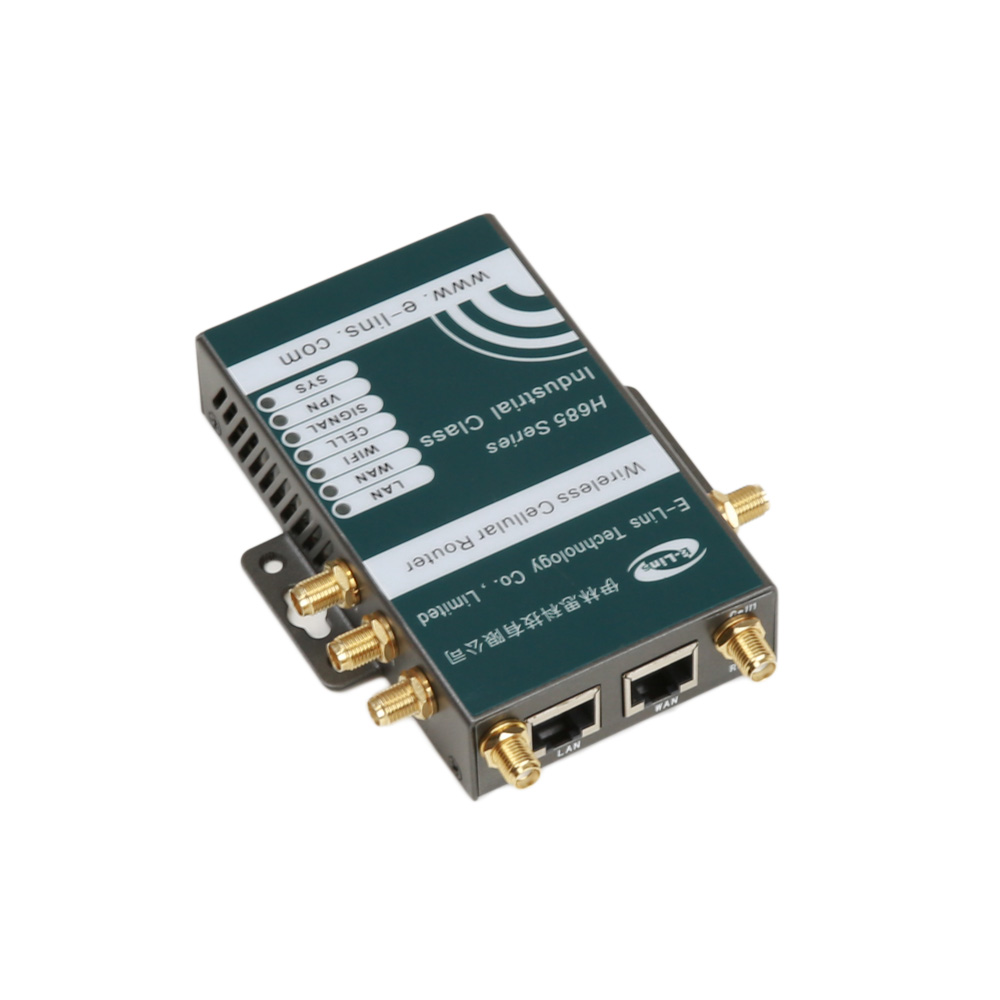
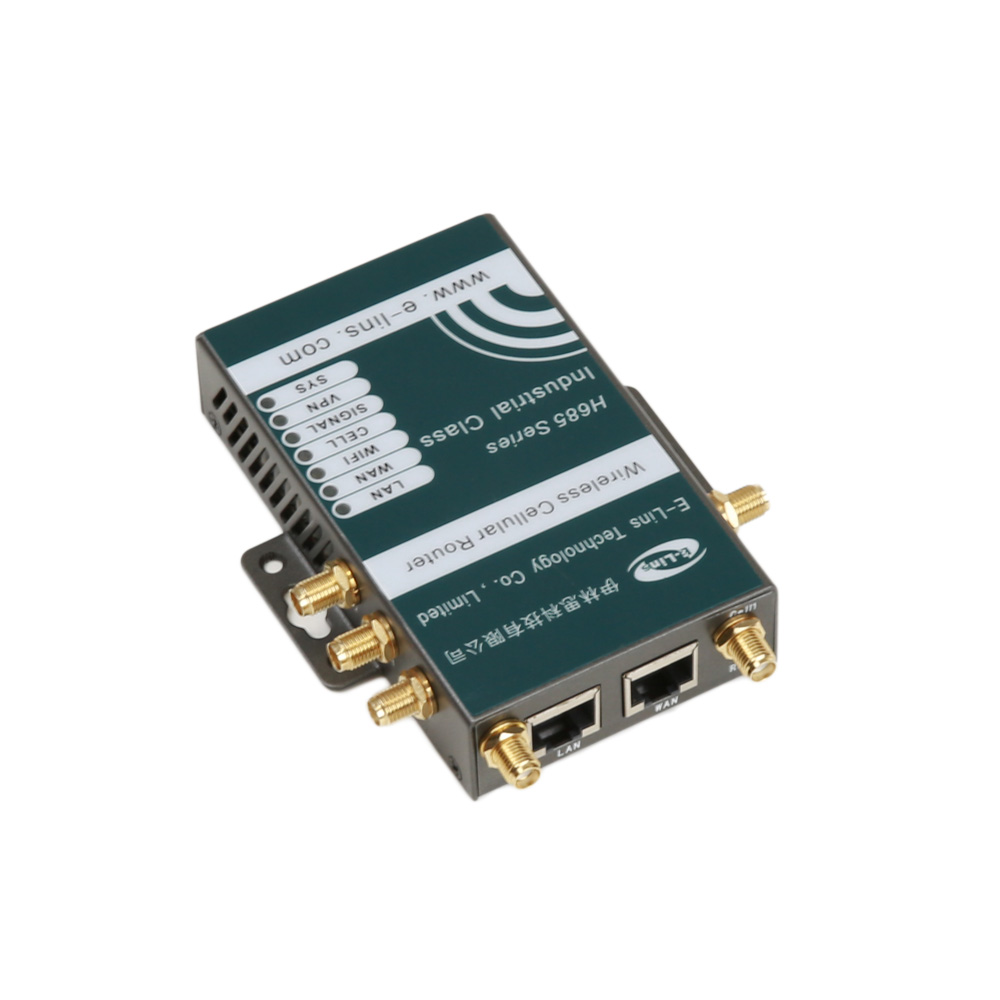
The H685f/H685 Mini Embedded Series provides a compact 100 × 60 × 21 mm form factor with Ethernet, RS232/RS485 and DI/DO interfaces. This makes the series relevant to space-constrained integration projects such as kiosks, robots, and other embedded systems.
For legacy devices that already use serial communications, the M300/M400 Industrial 4G Modems provide RS232/RS485-to-4G conversion and serial transparent transmission.
These existing products are important when assessing E-Lins as an industrial cellular manufacturer because they demonstrate experience with the interface and integration problems that often determine whether a wireless communication project is straightforward or difficult.
How E-Lins Builds Its 5G Industrial Communication Portfolio
E-Lins's current product portfolio includes both 5G industrial routers and industrial cellular modems and DTUs.
The H900f Gigabit 5G Industrial Router is positioned for high-bandwidth industrial IoT applications. It supports 5G SA/NSA dual-mode connectivity, Gigabit-class transmission, dual SIM hot backup, and PoE++.
For applications where the cellular device also functions as the main network gateway, this type of product provides a complete platform rather than only a cellular communications component.
The distinction is important for buyers searching for a Chinese industrial 5G cellular modem factory.
Not every project requires the same device architecture. Some customers may need a complete industrial 5G router. Others may need a compact embedded cellular communication product. Still others may need a communication device adapted to an existing industrial controller or machine.
E-Lins's combination of 5G industrial router development, 4G modem experience, embedded products, and OEM/ODM services provides a broader base for project discussions. For a specific project requiring a 5G modem-level embedded design, the exact cellular architecture and product configuration should be confirmed with E-Lins engineering rather than assumed from a standard catalogue product.
OEM and ODM Capability Is Critical for Industrial Integration
Industrial buyers often have requirements that do not fit a standard retail networking product.
An equipment manufacturer may need a different enclosure. A machine builder may require a specific serial interface. A system integrator may need customised firmware settings. A large project may require a defined configuration template before devices leave the factory.
This is where OEM and ODM capability becomes useful.
E-Lins provides OEM/ODM services and has a history of supplying communication equipment for global brands. Its accumulated manufacturing and development experience allows customers to discuss hardware and software requirements with a supplier that operates its own R&D and production functions.
What Should Be Discussed During an ODM Project?
A technical discussion should normally include the following areas:
Mechanical integration:
Dimensions, mounting, connectors, and installation position.
Electrical design:
Input voltage, power consumption, protection, and ignition-related requirements where relevant.
Cellular networking:
Target countries, operator compatibility, supported LTE/5G bands, and deployment architecture.
Interfaces:
Ethernet, RS232, RS485, DI/DO, or other required communication interfaces.
Software:
VPN, remote management, automatic recovery, configuration rules, and firmware update procedures.
Management platform:
TR-069, SNMP, SSH, or NMS integration requirements.
Production:
Pilot samples, validation procedures, batch production, and version control.
Taking these requirements into account at the beginning is generally much more effective than trying to modify networking equipment after deployment.
Quality Certifications Should Be Verified at Product Level
A Chinese factory may have many years of manufacturing experience, but procurement teams still need to verify the compliance status of the actual product being purchased.
E-Lins holds or supports certifications and compliance, including ISO 9001, ISO 14001, CE, FCC, RoHS, and UKCA.
For international projects, buyers should confirm the exact certification applicable to the selected model and destination market. Cellular products can have different regional requirements depending on their radio configuration and final application.
A good factory should be able to provide the relevant documentation and explain which certification applies to each product configuration.
Real Industrial Deployment Experience Is a Strong Supplier Indicator
Factory claims become more useful when they can be connected to actual industrial deployment experience.
E-Lins has supplied communication equipment to customers in more than 150 countries and regions and reports experience with large-scale operator projects.
One documented project involved remote telecom infrastructure in India operating under unstable power conditions and temperatures reaching 48°C. E-Lins reports a 99.4% equipment online rate for that deployment, alongside reduced site maintenance costs and large-scale management improvements across 100,000 supplied units.
Another deployment involved a European aviation ground support equipment integrator. The communication equipment was used to connect aircraft ground power and air-conditioning equipment on airport aprons where electromagnetic interference was a consideration. E-Lins reports an equipment online rate of at least 99.9%, with 85% of faults handled remotely through its 4G/VPN solution.
These examples do not prove that every future 5G project will produce the same results. They do, however, show why previous experience with difficult industrial communication environments is relevant when qualifying a supplier.
What to Ask a Chinese Industrial 5G Cellular Factory Before Ordering
A structured supplier questionnaire can make factory comparisons much more useful.
Instead of asking only, “Do you have a 5G modem?”, procurement teams should ask:
Technical Questions
Can the factory support the required 5G architecture and target regional bands?
Does the supplier develop its own firmware?
How are network recovery and watchdog functions implemented?
Which industrial interfaces are available?
Which VPN and remote-management protocols are supported?
Can the product be integrated into an existing industrial gateway or control system?
Manufacturing Questions
Is SMT and final assembly performed in-house?
What is the monthly manufacturing capacity?
How are component and firmware revisions controlled?
What testing is performed before shipment?
Can the supplier support both pilot quantities and subsequent mass production?
Project Support Questions
Does the supplier provide OEM/ODM development?
Can engineers support configuration and integration remotely?
What is the firmware upgrade policy?
What technical support channels are available after deployment?
Can the supplier provide documentation and configuration guidance for system integrators?
These questions create a much clearer picture of whether a supplier is suitable for a long-term industrial project.
When a Chinese Factory Is a Practical Choice for 5G Industrial Projects
For international buyers, sourcing directly from a Chinese manufacturer can provide access to an established electronics manufacturing ecosystem and direct communication with the factory's engineering team.
The value is greatest when the project requires a combination of product customisation, industrial hardware, communication firmware, and scaled production.
It can also make sense when the buyer wants a supplier capable of supporting several generations of industrial cellular products rather than purchasing unrelated equipment from multiple vendors.
E-Lins's development history illustrates this type of progression. The company began with industrial 2G/3G modems for applications including power grids and oil fields, expanded into 3G industrial routers and DTUs, developed complete 4G LTE product lines, and later expanded its portfolio into 5G NR industrial routers and edge-related gateways.
That historical continuity is relevant because industrial cellular engineering builds on experience with radio communication, industrial interfaces, firmware, remote management, and field deployment rather than only on the latest generation of cellular technology.
Conclusion: Look for a Factory With Industrial Communication Depth
Finding a Chinese industrial 5G cellular modem factory is ultimately a supplier-qualification task, not simply a product search.
The important factors include independent R&D, industrial-grade hardware, cellular networking expertise, firmware ownership, SMT and assembly capability, interface integration, OEM/ODM support, international certifications, production scalability, and long-term technical service.
5G is becoming an increasingly important connectivity option for industrial applications, but current industry guidance also makes clear that industrial networks generally combine multiple connectivity technologies according to the equipment, mobility, coverage, bandwidth, reliability, and security requirements of each use case.
For companies evaluating Chinese manufacturers, E-Lins Technology offers a combination of industrial wireless communication experience, in-house manufacturing, independent software development, and a product portfolio spanning 4G modems and DTUs through 4G and 5G industrial routers.
For a standard 5G industrial networking requirement, the H900f provides a 5G industrial router platform with dual-SIM backup, Gigabit connectivity, and PoE++. For legacy industrial equipment, the M300/M400 series provides a practical 4G modem-to-serial connection approach. For compact equipment integration, the H685f/H685 Mini Series provides an embedded form factor with industrial interfaces.
The most important consideration is therefore not whether a supplier simply uses the words “5G cellular modem factory”. It is whether the manufacturer has the engineering, manufacturing, and support infrastructure required to turn cellular connectivity into a reliable industrial product and maintain that product throughout its deployment lifecycle.