Description
A lunch cooler bag is expected to do one simple job—keep food at the right temperature until it's time to eat. In practice, buyers usually care about much more than insulation. The fabric has to withstand daily handling, the seams need to support repeated loading, and the structure should remain stable after thousands of production cycles. For companies purchasing promotional lunch bags or developing private-label products, these details often determine whether customers continue using the bag or replace it after only a few weeks.
This 600D Oxford lunch cooler bag is designed for everyday use in offices, schools, outdoor activities and food delivery. The outer shell uses durable Oxford fabric to resist abrasion, while the interior combines insulating foam with an aluminum foil lining to help slow temperature transfer. Rather than focusing on appearance alone, the construction is intended to balance thermal performance, durability and manufacturing efficiency, making it suitable for wholesale and OEM production.
Built Around Daily Use Instead of One-Time Promotions
Many insulated bags are purchased for promotional campaigns but quickly end up unused because they are either too small, difficult to clean or uncomfortable to carry. During product development, these practical issues are usually discussed before logo placement or color selection.
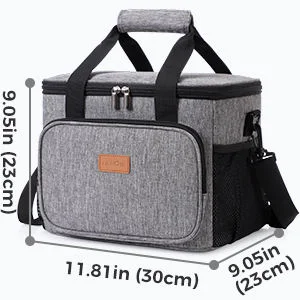
A capacity of approximately 24 liters allows the bag to carry lunch containers, bottled drinks and fresh groceries without becoming oversized for commuting. The rectangular opening provides easier access than narrow top-opening designs, especially when users need to pack multiple food containers.
The adjustable shoulder strap offers another carrying option when the bag becomes fully loaded. Reinforced stitching around the handles reduces stress concentration, helping the bag remain stable during repeated lifting.
Why 600D Oxford Fabric Is Commonly Used
Material selection directly affects both manufacturing cost and product lifespan. While lighter polyester fabrics reduce weight, they may lose shape after long-term use. Heavier fabrics improve durability but increase shipping costs and sewing difficulty.
For many commercial cooler bags, 600D Oxford fabric provides a practical balance. Its woven structure offers good abrasion resistance while remaining flexible enough for folding and storage. The coated surface also makes routine cleaning easier after exposure to food spills or outdoor environments.
Inside the bag, high-density EPE foam creates the primary insulation layer. The aluminum foil lining reflects radiant heat while providing a surface that can be wiped clean after each use. Although insulation time always depends on ambient temperature and ice pack usage, this multi-layer construction performs well for daily lunch storage, grocery transport and short outdoor trips.
Customization Starts with the Structure
Many buyers think customization means changing the logo. From a manufacturing perspective, branding is usually one of the final production steps.
The first discussion normally focuses on how the bag will actually be used. A supermarket promotion may require lightweight construction to reduce shipping costs. A meal delivery company may need additional reinforcement around the base. A retail brand may prefer cleaner stitching and premium accessories to match existing product collections.
Because of these differences, almost every structural element can be adjusted during OEM production, including dimensions, insulation thickness, pocket layout, shoulder straps, zipper specifications and printing methods. These changes often improve product performance more than changing the exterior appearance alone.
Manufacturing Consistency Matters More Than Individual Samples
A prototype can look excellent even when the production process is unstable. Bulk manufacturing presents different challenges. Fabric color must remain consistent across production batches, stitching quality needs standardized inspection, and every printed logo should appear in exactly the same position.
Factories therefore spend considerable effort controlling production rather than simply making samples. Incoming materials are inspected before cutting begins, sewing specifications are standardized for critical load-bearing areas, and finished products are checked for appearance, dimensions, zipper performance and overall workmanship before packing.
For wholesale buyers, this consistency is usually more valuable than reducing the unit price by a few cents because it minimizes quality claims after delivery.
Typical Specifications
| Item | Details |
|---|---|
| Material | 600D Oxford + EPE Foam + Aluminum Foil |
| Capacity | Approximately 24L |
| Size | 30 × 23 × 23 cm or customized |
| Logo | Screen Printing, Heat Transfer, Embroidery |
| Color | Customized |
| MOQ | 500 pieces |
| Sample Lead Time | 7–15 days |
| Production Lead Time | 30–45 days |
| OEM & ODM | Available |
Suitable Applications
Instead of serving a single purpose, this insulated cooler bag is commonly adapted for different commercial markets. Retailers use it as a reusable shopping cooler, food delivery companies customize it for meal transport, and corporate brands frequently choose it for promotional campaigns where practical products create stronger brand exposure than disposable giveaways.
Its combination of durability, reusable construction and customizable design also makes it suitable for supermarkets, outdoor brands, employee gift programs and private-label product lines looking for reliable long-term production.

Reviews
There are no reviews yet.