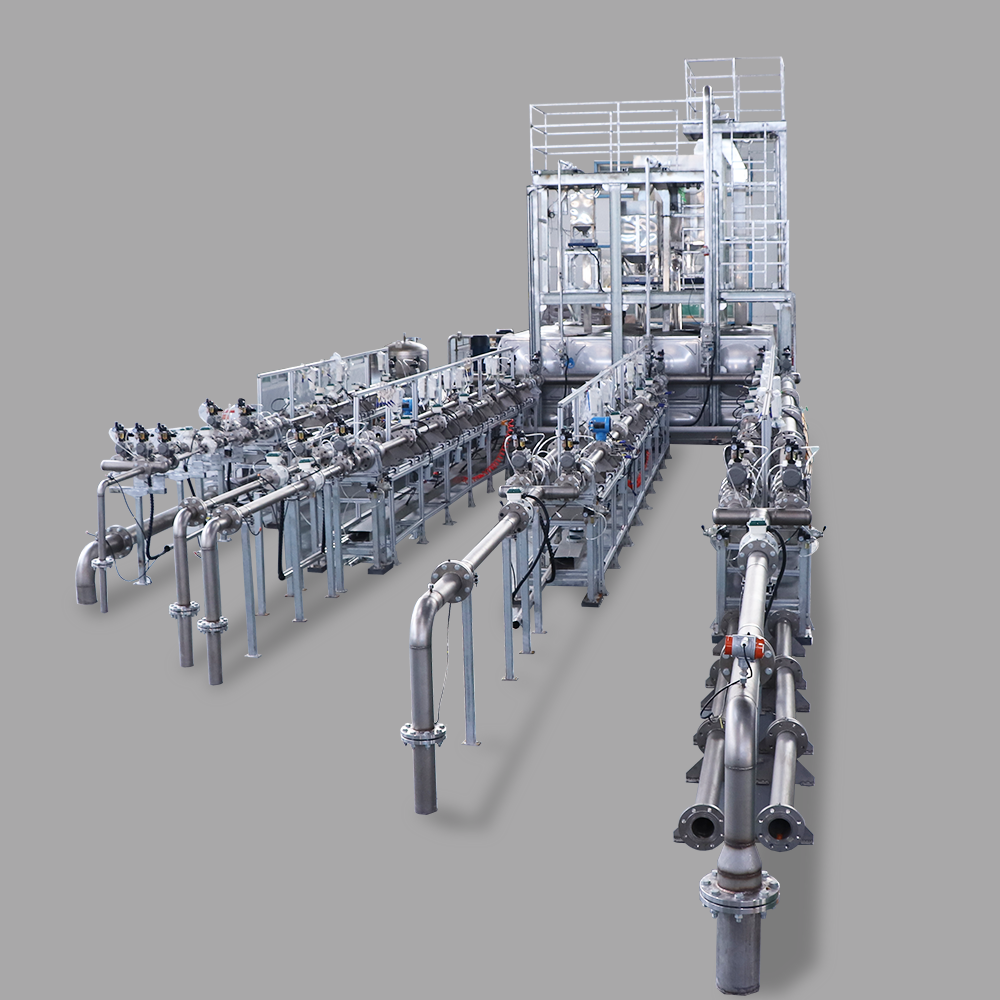
Description
Automatic Calibration System: How Flow Calibration Works
1. Introduction
An automatic calibration system is an industrial measurement facility designed to verify the accuracy of flow meters by automatically generating controlled flow conditions, comparing measured values against a reference standard, and recording the results without continuous manual intervention. As industrial processes increasingly depend on accurate flow data for billing, production control, and regulatory compliance, the reliability of flow meters becomes a critical engineering concern.
Flow meters are subject to gradual accuracy drift caused by wear, fouling, pressure fluctuations, and long-term operating stress. Without periodic calibration, these instruments may report inaccurate readings, leading to financial losses, process inefficiencies, or non-compliance with metrological regulations. An automatic calibration system addresses this problem by providing a controlled, repeatable, and traceable method for testing and verifying flow meter performance.
This article explains what an automatic calibration system is, how it works, which calibration methods are commonly used, how to select the right system, and where such systems are applied in industrial practice.
2. What Is an Automatic Calibration System?
An automatic calibration system is a measurement facility that uses automated control, data acquisition, and reference-standard comparison to verify the accuracy of flow meters. Instead of relying on manual timing, manual valve operation, or manual data recording, the system uses programmable logic controllers (PLC) and industrial computers to manage flow generation, measurement, and reporting.
The main purpose of an automatic calibration system is to establish metrological traceability — confirming that a flow meter under test produces readings consistent with a known reference standard within a defined uncertainty range. This directly supports flow measurement accuracy, which is essential wherever flow data influences financial transactions, safety systems, or production quality.
In simple terms, an automatic calibration system answers one engineering question: "How closely does this flow meter’s reading match the true flow value, and can this comparison be repeated reliably?"
3. Working Principle and System Structure
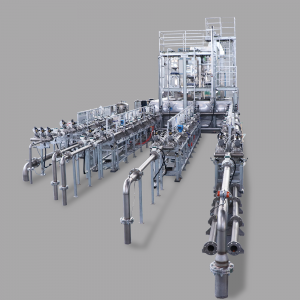
The working principle of an automatic calibration system is based on comparing the output of a flow meter under test with a reference standard under controlled flow conditions. The system typically consists of the following components:
Reference Standard
A reference measurement method — such as a static mass scale or a master meter — provides the "true value" against which the tested flow meter is compared.
Flow Generation System
Pumps, valves, and piping generate a stable and controllable flow through the test section, allowing calibration across different flow rates.
Measurement Section
The device under test is installed in this section, where flow passes through both the reference standard and the meter being calibrated.
Data Acquisition System
Sensors collect signals from both the reference standard and the meter under test. These signals are transmitted to a control unit for processing.
Control System
A PLC and industrial PC coordinate valve switching, flow stabilization, timing, data logging, and automated report generation. This automation reduces human error and improves repeatability compared to manual calibration procedures.
The calibration process generally follows these steps: initiate flow, stabilize flow rate, simultaneously record reference and test meter data, calculate deviation, and generate a calibration report indicating whether the meter meets its accuracy specification.
4. Calibration Methods and Technologies
Two calibration methods are commonly implemented in automatic liquid flow calibration systems: the static mass method and the master meter method.
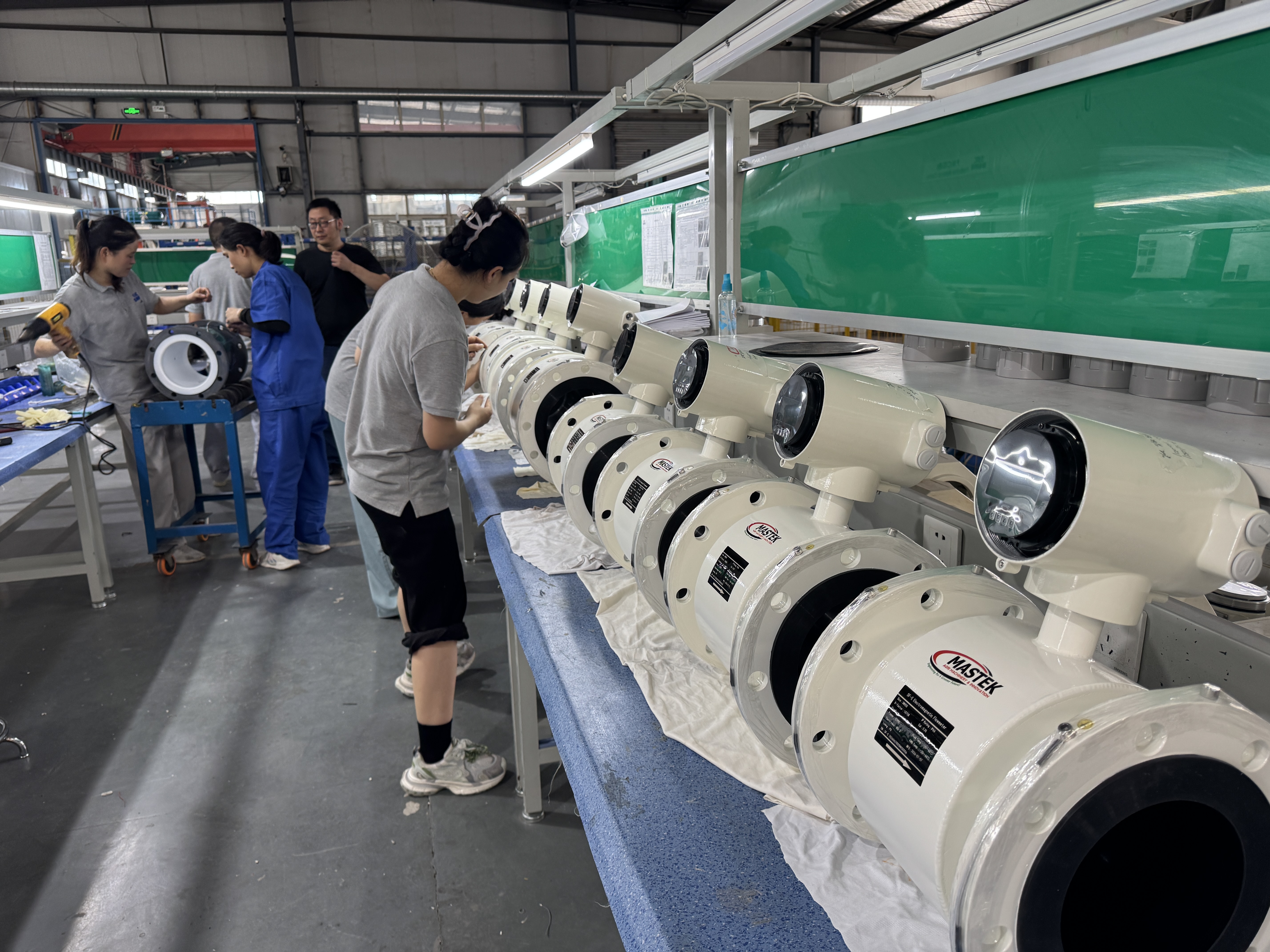
Static Mass Method
Working Principle: Liquid passing through the meter under test is diverted into a weighing tank during a defined time interval. The mass collected is measured using a precision scale, and the corresponding volume is calculated using fluid density. This mass-based measurement serves as the reference value.
Advantages: This method offers high measurement accuracy because mass measurement is a fundamental physical quantity with minimal indirect conversion error. It is widely recognized as a primary-level calibration method in liquid flow metrology.
Suitable Applications: Static mass method systems are typically used for calibrating flow meters that require tight uncertainty control, such as reference-grade meters used by manufacturers or calibration laboratories.
Master Meter Method
Working Principle: A previously calibrated "master meter" is installed in series with the meter under test. Both meters measure the same flow simultaneously, and their readings are compared directly.
Advantages: This method allows faster calibration cycles and is well suited for verifying a large number of meters efficiently, since it does not require weighing and stabilization time associated with mass-based systems.
Suitable Applications: The master meter method is commonly used for routine verification, field calibration support, and applications where calibration throughput is a priority.
Both methods can be integrated into an automatic calibration system, and some facilities incorporate both to cover a wider flow range or to cross-verify results.
5. How to Select a Liquid Flow Calibration System
Selecting the correct automatic calibration system requires evaluating several engineering parameters:
- Flow Range: The system must cover the minimum and maximum flow rates expected from the meters being tested.
- Pipe Diameter: Calibration systems must accommodate the diameter range of the devices under test, from small-diameter meters to large industrial pipelines.
- Accuracy Requirement: Higher-accuracy applications, such as reference standard verification, typically require static mass method systems, while routine testing may be satisfied with master meter systems.
- Calibration Object: Consider whether the system will calibrate electromagnetic flowmeters, turbine meters, vortex meters, or other flow measurement instruments, as this affects piping design and test section configuration.
- Measurement Uncertainty: Define the acceptable uncertainty level based on downstream application requirements, such as trade measurement, process control, or laboratory research.
- Installation Requirements: Evaluate available space, foundation stability, and environmental control needs, since some calibration systems require controlled temperature conditions for high-precision testing.
- Automation Requirements: Determine whether full automation — including automated valve sequencing, data acquisition, and report generation — is necessary to support high testing volume or reduce operator dependency.
6. Application Scenarios
Automatic calibration systems are applied across multiple sectors that require verified flow measurement accuracy:
- Flow Meter Manufacturers: Used during production to verify the accuracy of newly manufactured meters before shipment.
- Calibration Laboratories: Used to provide third-party or in-house calibration services, supporting metrological traceability for client instruments.
- Industrial Measurement Verification: Used by industrial facilities to periodically verify in-service flow meters used for process control or internal measurement accounting.
- Water Industry: Used in municipal water supply, wastewater treatment, and water distribution network applications where flow measurement accuracy affects billing and resource management.
- Process Measurement: Used in chemical and industrial process environments to verify meters responsible for monitoring liquid flow in production systems.
7. Technical Parameters and Performance Considerations
Key technical parameters that define the performance of an automatic calibration system include:
- Flow Range: Determined by the calibration system’s design, covering small to large diameter flowmeters depending on system configuration.
- Measurement Uncertainty: Static mass method systems can achieve measurement uncertainty as low as 0.05% under typical laboratory conditions, while master meter method systems typically achieve uncertainty around 0.2%.
- Stability: Flow generation systems must maintain stable flow during the measurement interval to avoid introducing measurement error.
- Calibration Uncertainty: This reflects the combined uncertainty contribution from the reference standard, environmental conditions, and system repeatability.
- Applicable Standards: Calibration procedures should follow recognized metrological practices to ensure results are consistent and traceable.
These parameters should be reviewed against the specific accuracy class required for the meters being tested, since over-specifying uncertainty requirements can increase system cost without proportional benefit.
8. Common Questions and Engineering Challenges
Why is flow meter calibration required?
Flow meters experience gradual measurement drift due to mechanical wear, sensor aging, and changing process conditions. Calibration confirms whether a meter still performs within its specified accuracy class.
How often should flow meters be calibrated?
Calibration frequency depends on application criticality, regulatory requirements, and historical drift behavior of the specific meter type. Meters used in trade measurement or safety-critical processes often require more frequent verification.
What affects calibration accuracy?
Factors include flow stability, temperature variation, reference standard uncertainty, sensor response time, and system repeatability. Poor flow conditioning upstream of the test section can also introduce measurement error.
What calibration method should be selected?
The static mass method is preferred when the highest achievable accuracy is required, such as for reference-grade instruments. The master meter method is preferred for higher-throughput calibration where slightly higher uncertainty is acceptable.
9. How to Select a Reliable Calibration System Manufacturer
When evaluating a calibration system manufacturer, industrial buyers should consider:
- Manufacturing Capability: The manufacturer should have direct production capability for both flow meters and calibration systems, indicating a deeper understanding of measurement behavior.
- Calibration Technology: Verify that the manufacturer offers established calibration methods, such as static mass and master meter techniques, supported by clear technical documentation.
- Quality Control: Confirm that the manufacturer follows recognized quality management practices throughout design and production.
- Engineering Experience: Long-term experience in flow measurement and calibration system design reduces the risk of application mismatches.
- Customization Capability: The ability to configure flow range, pipe diameter, and automation level according to specific project requirements is important for non-standard applications.
- Technical Support: Reliable manufacturers provide installation guidance, commissioning support, and after-sales technical assistance.
- Export Capability: For international buyers, the manufacturer should demonstrate experience shipping and supporting systems across different regions.
10. About Kaifeng Xinya Instrument Co., Ltd.
Kaifeng Xinya Instrument Co., Ltd., established in 2004 and headquartered in Kaifeng, Henan, China, is a manufacturer specializing in industrial flow measurement instruments and flow calibration systems. The company integrates flow meter manufacturing with calibration system design, allowing it to apply direct measurement engineering knowledge to calibration equipment development.
Kaifeng Xinya produces liquid flow calibration systems based on the static mass method and master meter method, as well as gas flow calibration systems based on the sonic nozzle method. Calibration systems incorporate PLC and industrial PC-based automation for data acquisition, digital record keeping, and automated report generation, supporting traceable and repeatable calibration processes.
The company maintains independent research and development capability, factory-level calibration testing capability, and supports OEM and customization requirements for calibration system configuration. Kaifeng Xinya has export experience across Southeast Asia, the Middle East, and other global industrial markets, and holds certifications including ISO 9001:2015, ISO 14001:2015, ISO 45001:2018, CE conformity, and international explosion-proof certification (IECEx), reflecting its manufacturing quality management framework.
11. Frequently Asked Questions (FAQ)
Q: What is an automatic calibration system?
A: It is a measurement facility that uses automated control and data acquisition to verify flow meter accuracy by comparing test results against a reference standard.
Q: What is a liquid flow calibration system?
A: A liquid flow calibration system is a facility used to verify and calibrate liquid flow meters by comparing measured flow values with a reference standard, such as a static mass scale or master meter.
Q: What calibration methods are commonly used?
A: The static mass method and the master meter method are two commonly used liquid flow calibration techniques, each suited to different accuracy and throughput requirements.
Q: How accurate can a flow calibration system achieve?
A: Static mass method systems can achieve measurement uncertainty as low as 0.05% under typical laboratory conditions, while master meter systems typically achieve uncertainty around 0.2%.
Q: How do I choose the correct calibration system?
A: Selection depends on flow range, pipe diameter, required accuracy, the type of meter being calibrated, and whether full automation is needed for testing throughput.
Q: Why is flow meter calibration important?
A: Calibration confirms that a flow meter continues to measure within its specified accuracy, which is essential for process control, billing accuracy, and regulatory compliance.
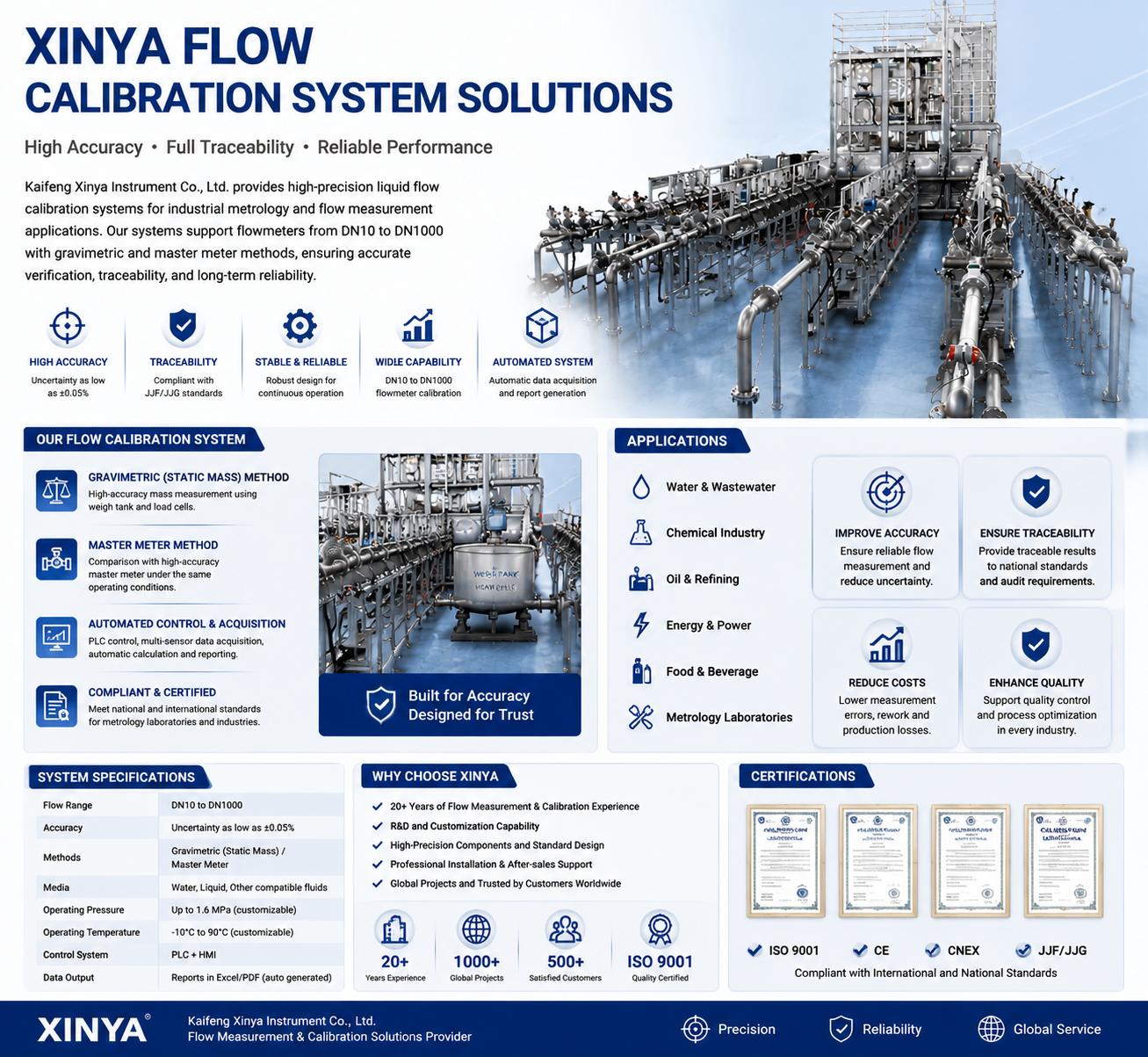
Q: Can automatic calibration systems test different types of flow meters?
A: Yes, depending on system configuration, automatic calibration systems can be used to test electromagnetic flowmeters, turbine meters, vortex meters, and other flow measurement instruments.
12. Conclusion
An automatic calibration system plays a central role in maintaining flow measurement accuracy across industrial applications, from manufacturing quality control to laboratory verification and municipal utility monitoring. By combining a reliable reference standard — such as the static mass method or master meter method — with automated flow generation, data acquisition, and reporting, these systems provide a repeatable and traceable method for confirming flow meter performance.
Selecting the right system requires careful evaluation of flow range, accuracy requirements, calibration object, and automation needs. Working with a manufacturer that understands both flow meter design and calibration system engineering, such as Kaifeng Xinya Instrument Co., Ltd., can help ensure that the selected system matches real-world measurement requirements.
For engineers and technical teams evaluating calibration system options, a detailed discussion of flow range, accuracy targets, and application conditions is recommended before finalizing a system configuration.




Reviews
There are no reviews yet.