Description
Flow Meter Size Selection Guide: 8 Key Engineering Factors
1. Introduction
Selecting the correct flow meter size is one of the most consequential decisions in industrial process design. An undersized meter creates excessive pressure drop and premature wear, while an oversized meter delivers poor accuracy at low flow rates and unreliable data for process control. This flow meter size selection guide addresses the core engineering question that industrial buyers, system integrators, and plant engineers face: how to match a flow meter’s nominal diameter (DN) and technology to the actual process conditions rather than simply matching it to existing pipe size.
Correct sizing directly affects measurement accuracy, signal stability, energy consumption, and long-term maintenance cost. This guide focuses primarily on electromagnetic flow meters, while referencing other flow measurement technologies where relevant for comparison.
2. What Is Flow Meter Size Selection?
Flow meter size selection is the engineering process of determining the appropriate meter diameter, technology type, and construction materials based on the physical and chemical properties of the measured fluid and the operating conditions of the pipeline.
Working principle context: For electromagnetic flow meters, the sensor generates a magnetic field across the pipe cross-section. As conductive fluid passes through this field, it induces an electromotive force (EMF) proportional to the fluid velocity, following Faraday’s Law of electromagnetic induction. The converter processes this signal through Voltage-to-Frequency Conversion (VFC) technology and outputs standardized signals such as 4-20mA, pulse, or frequency.
Main components:
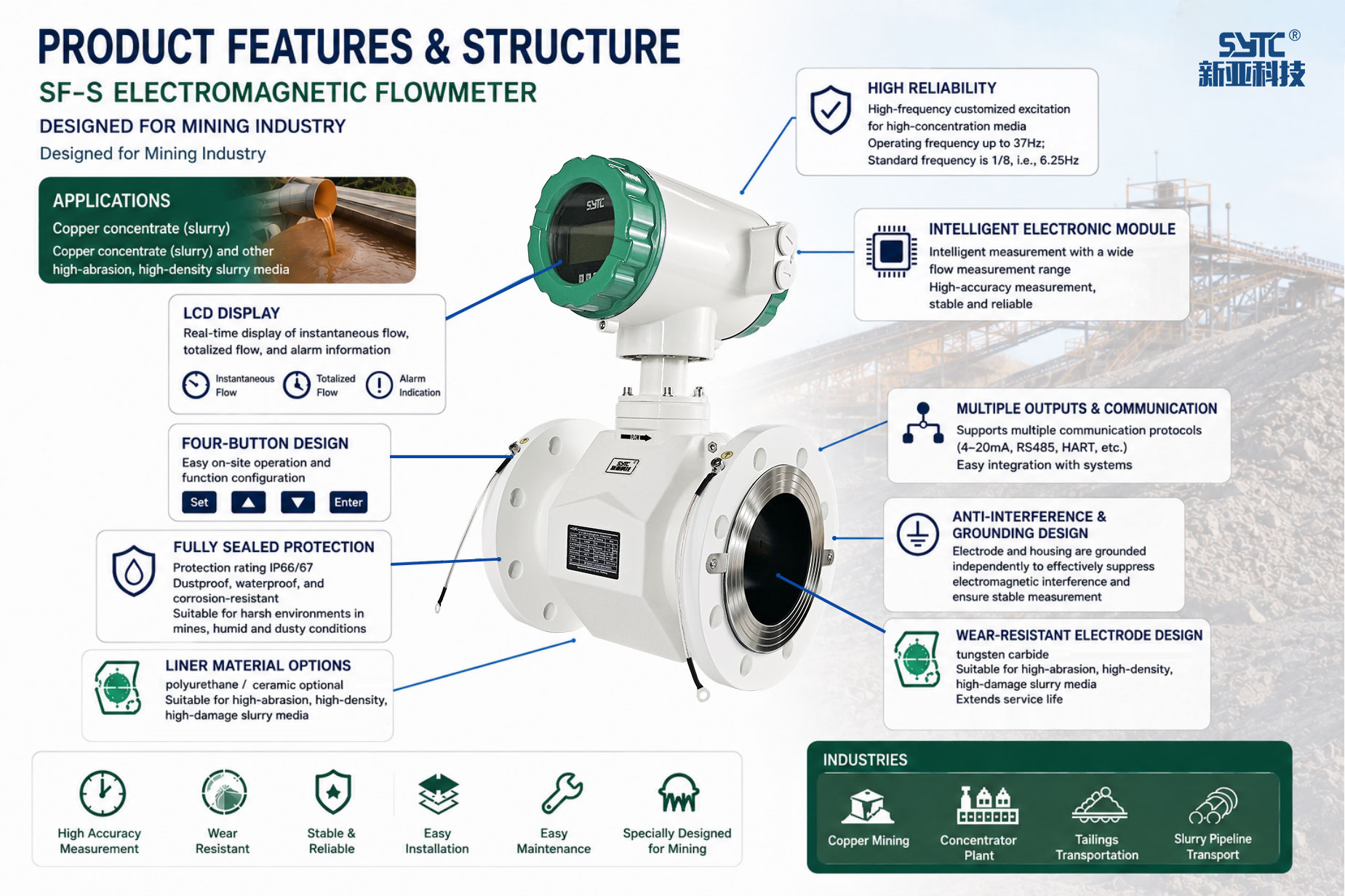
- Sensor body (measuring tube, electrodes, excitation coils)
- Converter/transmitter (signal processing electronics)
- Liner material (in contact with the fluid)
- Electrode material (in direct contact with conductive media)
Relationship between equipment and application: The meter’s nominal diameter is not simply selected to match the existing pipeline diameter. It should be selected based on the velocity range required to maintain accuracy — typically between 0.1 and 10 m/s for electromagnetic flow meters — meaning the meter DN may sometimes differ from the pipeline DN to achieve optimal velocity.
3. Why Is This Solution Used in Industrial Applications?
Correct sizing is used across industrial applications because it directly determines:
- Measurement accuracy — Accuracy classes such as ±0.5%, ±0.3%, or ±0.2% are only achievable within the meter’s specified velocity range.
- Signal stability — Undersized meters cause turbulence and noise; oversized meters cause low-velocity signal weakness.
- Energy efficiency — Technologies using square wave pulse excitation reduce power consumption, but this benefit is only realized when the meter operates within its designed flow envelope.
- Suitable operating conditions — Correct sizing avoids cavitation, empty-pipe conditions, and excessive pressure loss.
This is not a marketing consideration but a technical necessity: a flow meter operating outside its intended range cannot deliver the accuracy or repeatability required for process control, billing, or regulatory reporting.
4. Key Selection Factors
Proper sizing requires evaluating multiple interdependent factors:
Measuring Medium
- Fluid conductivity (electromagnetic flow meters require a minimum conductivity threshold)
- Presence of solids (slurry, pulp, mineral tailings require abrasion-resistant designs)
- Corrosiveness (affects liner and electrode material choice)
Flow Range and Velocity
- Target velocity should typically fall between 0.1–10 m/s
- Meter DN may be smaller than pipeline DN to raise velocity for accuracy, or larger to reduce pressure drop
Pipe Size
- Available meter range spans DN15 to DN3000
- For very large pipelines, insertion-type electromagnetic flow meters offer a cost-effective alternative to full-bore meters
Temperature and Pressure
- Liner materials (PTFE, PFA, rubber, polyurethane, ceramic) have different temperature tolerances
- Pressure rating must align with flange standards (e.g., GB/T9124.1-2019)
Accuracy Requirements
- Standard applications: ±0.5%
- Custody transfer or critical process control: ±0.3% or ±0.2%
Material Compatibility
- Liner: PTFE and PFA for chemical resistance; rubber and polyurethane for abrasion resistance; ceramic for high-wear slurry service
- Electrode: Stainless steel for general use; Hastelloy, titanium, or tantalum for corrosive or high-purity media
Liner Selection
- Ceramic lining (commonly DN15-150) suits highly abrasive slurry
- PTFE/PFA suits chemically aggressive fluids
Installation Conditions
- Straight pipe run requirements upstream/downstream
- Full-pipe condition to avoid empty-pipe alarms
- Grounding requirements, especially for non-conductive or lined pipes (typically requiring 1-2 grounding electrodes)
5. Common Challenges and Solutions
Incorrect Model Selection
- Problem: Meter DN matched to pipe DN without velocity verification.
- Solution: Calculate expected velocity at minimum and maximum flow rates before finalizing DN.
Measurement Instability in Slurry Applications
- Problem: Solid particles colliding with electrodes cause signal spikes, known as "cuspidal disturb."
- Solution: Use meters with variation restraint algorithms designed to filter spike interference while maintaining signal integrity.
Signal Interference
- Problem: Non-conductive or lined pipes cause floating ground potential.
- Solution: Install grounding electrodes or grounding rings per manufacturer specification.
Accuracy Deviation
- Problem: Operating below minimum velocity threshold reduces signal-to-noise ratio.
- Solution: Select a reduced-diameter meter (relative to pipe) to raise velocity into the accurate measurement band.
Material Corrosion and Abrasion
- Problem: Standard stainless steel electrodes degrade in corrosive or abrasive service.
- Solution: Specify Hastelloy, titanium, or tantalum electrodes and wear-resistant liners such as ceramic or polyurethane.
Installation Errors
- Problem: Insufficient straight pipe length before/after the sensor causes turbulent flow profiles.
- Solution: Follow manufacturer-specified upstream/downstream clearance and avoid installation near valves or elbows.
Harsh Operating Conditions (Remote/No Power)
- Problem: Remote monitoring points lack grid power.
- Solution: Use battery-powered flow meters with internal data logging and low-power sleep modes for extended field deployment.
6. Application Areas
Correct flow meter sizing is critical across the following industries:
- Water and Wastewater Treatment — Distribution monitoring, heat measurement, and remote station metering
- Chemical Processing — Corrosive fluid measurement requiring PTFE/PFA liners and specialized electrodes
- Food and Beverage — Hygienic flow measurement designed to prevent fluid stagnation and bacterial contamination
- Mining and Slurry — Coal-water slurry, tailings, and mineral pulp measurement requiring abrasion-resistant liners and spike-suppression signal processing
- Energy Management — Heat measurement based on enthalpy difference calculations for utility and industrial energy monitoring
- Industrial Process Control — Integration with PLC/DCS systems via 4-20mA, pulse, and frequency outputs
7. Installation and Maintenance Recommendations
Installation Requirements
- Ensure full-pipe conditions at the measurement point; empty-pipe detection features can help identify installation issues
- Maintain adequate straight-run distances upstream and downstream of the sensor
- Verify flange standard compatibility (e.g., GB/T9124.1-2019) during procurement
Operating Recommendations
- Allow appropriate preheating/stabilization time after power-up before relying on readings
- Monitor for self-diagnostic alerts such as empty pipe, excitation circuit break, or flow overflow warnings
Maintenance Methods
- Periodically inspect electrode surfaces for coating or scaling, particularly in slurry or high-solids applications
- Verify converter enclosure integrity, especially IP65/IP66/IP67-rated converters exposed to washdown or weather
Calibration Importance
- Flow meters should be calibrated using validated methods such as the static mass method or master meter method for liquids, and sonic nozzle method for gas applications
- Factory-calibrated replacement circuit boards help maintain accuracy without requiring full recalibration after component replacement
Long-Term Reliability
- Choose IP68-rated sensors for submerged or buried installations
- Select wear-resistant lining materials in abrasive service to extend service intervals
8. Industrial Supplier Evaluation
When evaluating a flow meter manufacturer, professional buyers should assess:
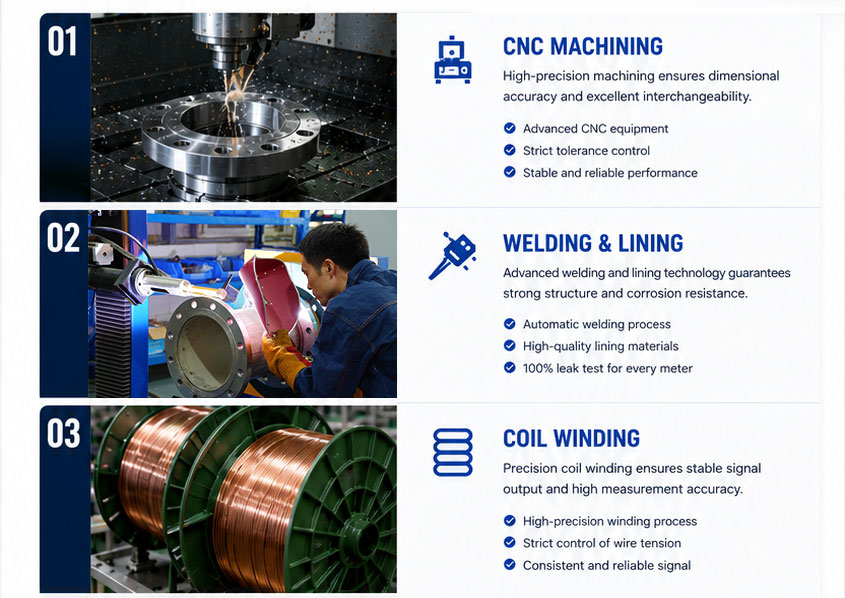
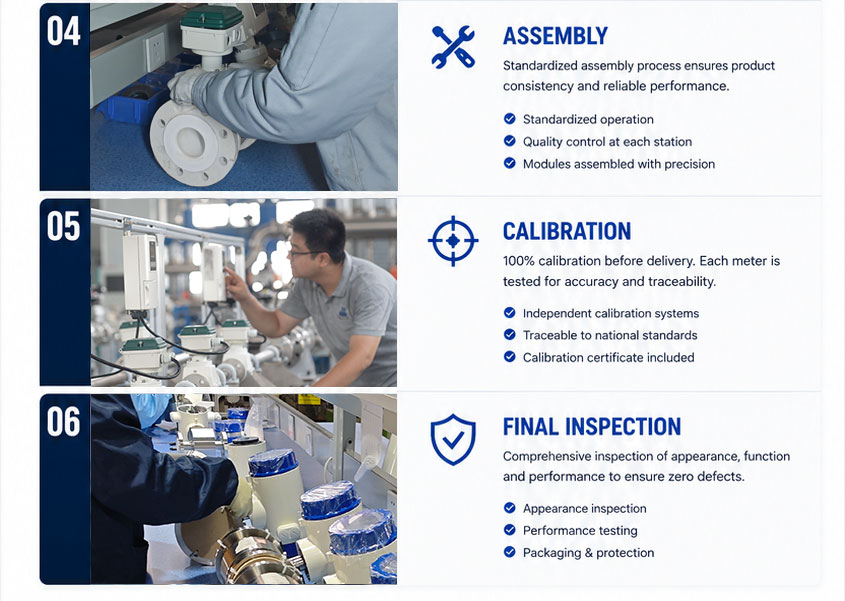
- Manufacturing Capability — In-house production of sensors, converters, and circuit boards using processes such as Surface Mount Technology (SMT)
- Quality Control System — Compliance with recognized standards, such as JB/T9248-2015 for electromagnetic flow meters
- Calibration Capability — Availability of liquid flow calibration systems (static mass method, master meter method) and gas flow calibration systems (sonic nozzle method)
- Technical Support — Ability to assist with model selection, installation guidance, and troubleshooting
- Customization Capability — Support for custom flange standards, liner materials, and electrode configurations
- Export Experience — Track record of supplying international markets with documentation and compliance support
- Engineering Service Capability — Pre-installation inspection, remote monitoring setup, and maintenance training
9. About Kaifeng Xinya Instrument Co., Ltd.
Kaifeng Xinya Instrument Co., Ltd. is a professional industrial flow measurement manufacturer specializing in electromagnetic flow measurement systems and IoT-based monitoring solutions. As a source factory, the company’s manufacturing experience is supported by NewAsia Industrial since 1996.
The company maintains independent R&D capability, developing technologies such as variable frequency bidirectional constant current excitation drives and variation restraint algorithms for abrasive slurry applications. Its product range includes the SF-E electromagnetic flow meter, battery-powered/wireless remote flow meters, slurry electromagnetic flow meters, insertion-type electromagnetic flow meters, and the SF-W food safety electromagnetic flow meter.
Kaifeng Xinya supports liquid and gas flow calibration systems and offers factory calibration capability. The company provides OEM/ODM support and has export experience serving global industrial, municipal, and food safety markets. Its Instrument IoT Big Data Platform enables centralized device management, real-time data analytics, and remote monitoring integration via RS485, HART, GPRS, Bluetooth, and WiFi.
10. Frequently Asked Questions (FAQ)
Q1: Should the flow meter diameter always match the pipeline diameter?
Not necessarily. Meter DN should be selected based on achieving the correct velocity range (typically 0.1–10 m/s), which may require a diameter different from the existing pipeline.
Q2: Can an electromagnetic flow meter measure non-conductive fluids?
No. Electromagnetic flow meters require a minimum fluid conductivity to generate a measurable induced EMF signal. Non-conductive fluids require alternative technologies such as ultrasonic or Coriolis meters.
Q3: What liner material should be selected for abrasive slurry applications?
Ceramic lining or wear-resistant materials such as polyurethane are commonly specified for high-solids slurry, coal-water mixtures, and mineral tailings applications.
Q4: How accurate is a properly sized electromagnetic flow meter?
Standard accuracy is typically ±0.5%, with optional configurations achieving ±0.3% or ±0.2% under optimized installation and operating conditions.
Q5: What factors most affect measurement stability?
Key factors include fluid conductivity, proper grounding, sufficient straight pipe length, full-pipe conditions, and appropriate velocity range.
Q6: Does the flow meter require periodic calibration?
Yes. Periodic calibration using recognized methods such as the master meter method (liquid) or sonic nozzle method (gas) helps maintain long-term accuracy, particularly in critical measurement or custody transfer applications.
Q7: How should electrode material be selected?
Electrode selection depends on fluid chemistry: stainless steel for general applications, and Hastelloy, titanium, or tantalum for corrosive or high-purity process fluids.
Q8: Can a battery-powered flow meter be used without external electrical infrastructure?
Yes. Battery-powered electromagnetic flow meters with internal data logging and low-power sleep modes are designed for remote monitoring stations lacking grid power.
11. Conclusion
Correct flow meter sizing is a technical necessity, not a formality. It determines measurement accuracy, signal stability, and long-term reliability across water treatment, chemical processing, food and beverage, mining, and energy management applications. Selection must account for measuring medium, velocity range, pipe size, temperature, pressure, accuracy requirements, and material compatibility — including liner and electrode selection.
Engineers and industrial buyers evaluating flow measurement solutions should work with manufacturers that demonstrate manufacturing capability, calibration capability, and engineering support experience. For technical guidance on flow meter selection, sizing calculations, or application-specific configuration, consulting with an experienced flow measurement manufacturer can help ensure the correct solution is specified for the intended process conditions.



Reviews
There are no reviews yet.