Description
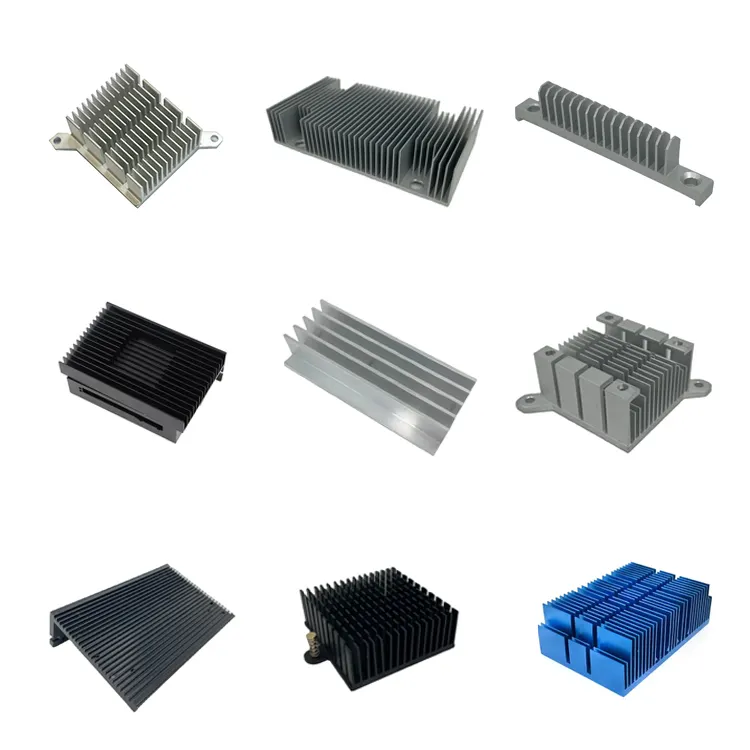
The CNC machining extruded heatsink offered by Vibo is engineered to deliver efficient, reliable, and high-precision thermal management for modern electronic systems. By combining aluminum extrusion with precision CNC finishing, this solution provides exceptional heat dissipation, customizable geometry, and manufacturing scalability suitable for both prototypes and mass-produced assemblies.
Advantages of CNC Machined Extruded Heatsink
Excellent Thermal Efficiency
The CNC machining extruded heatsink is produced using high-conductivity aluminum, allowing heat to spread quickly across the body. The extrusion process enables fin structures with optimized height, thickness, and spacing, expanding surface area and improving natural or forced convection.
Enhanced Structural Design Flexibility
Extrusion creates complex cross-sectional profiles, while CNC machining adds fine adjustments and intricate details. This hybrid method supports customized fin layouts, mounting features, threaded holes, pockets, cable channels, and cutouts that cannot be achieved with extrusion alone.
High Dimensional Accuracy
CNC machining refines the extruded profile to extremely tight tolerances. Critical features—such as the base flatness, hole alignment, and slot depths—can be machined to micrometer-level accuracy. This ensures perfect contact with thermal interface materials and consistent performance across batches.
Balanced Cost and Volume Scalability
Extrusion minimizes raw material waste and reduces cost for medium to high production volumes. CNC finishing adds precision without compromising efficiency. This combined approach offers a cost-effective and scalable solution for electronics requiring reliable thermal control.
Environmentally Sustainable Material Selection
Aluminum is fully recyclable, and the extrusion process produces minimal waste. The CNC machining stage also allows for effective chip recovery, contributing to environmentally responsible manufacturing.
Consistent and Customizable Surface Quality
After machining, the heatsink surface is smooth and flat. Optional finishing methods such as anodizing or powder coating enhance corrosion resistance, increase emissivity, and provide improved durability in harsh environments.
Manufacturing Process of Extruded CNC Finished Heatsink
1. Aluminum Extrusion of the Profile
The process begins with aluminum billets heated and pressed through a precision die, forming the desired cross-sectional profile. The result is a continuous shape with consistent fin geometry and stable structural properties.
2. Straightening and Aging Treatment
Extruded profiles undergo straightening to relieve stresses and aging to optimize mechanical strength and stability. This ensures consistent behavior during machining and long-term reliability.
3. Saw-Cutting to Working Length
Profiles are cut into sections with length tolerances suitable for the CNC stage. This prepares each piece for precision finishing without excessive waste.
4. CNC Machining for Fine Features
Multi-axis CNC equipment performs operations such as:
-
Face milling for a perfectly flat mounting surface
-
Drilling and tapping for mounting holes and threaded interfaces
-
Slotting and pocketing for air channels, cable access, or component integration
-
Edge trimming and contouring for refined fit and appearance
These steps ensure that each heatsink meets strict dimensional and functional requirements.
5. Detailed Quality Inspection
All critical features are measured using advanced inspection tools such as CMM equipment, surface flatness gauges, and precision calipers. This step ensures that tolerances, surface roughness, and mechanical characteristics are fully compliant.
6. Optional Surface Treatment
Depending on the application, additional finishing options—such as anodizing, powder coating, or chromate conversion—can be applied to enhance visual appeal, increase corrosion resistance, or improve thermal emissivity.
Application of CNC Machining Extruded Heatsink
The CNC machining extruded heatsink is widely used across industries requiring stable and efficient heat dissipation:
-
Power electronics including inverters, motor controllers, and rectifiers
-
LED lighting systems that operate under continuous high temperature
-
Telecommunications equipment such as server modules and network hardware
-
Electric vehicles and automotive electronics, including converters and battery systems
-
Computer hardware such as GPU modules, CPU cooling assemblies, and embedded systems
-
Industrial control devices that integrate high-power boards or compact enclosures
Its strength lies in adaptability, allowing engineers to tailor dimensions, mounting patterns, and fin geometry to equipment constraints.
Comparison With Other Heatsink Manufacturing Methods
Extruded + CNC Machined vs. Die-Cast Heatsinks
-
Precision: CNC finishing offers tighter tolerances than die-casting
-
Thermal conductivity: Extruded aluminum retains superior thermal performance due to lower material porosity
-
Customization: Extrusion supports more refined fin geometry and consistent cross-sections
Extruded + CNC Machined vs. Skived Fin Heatsinks
-
Cost: Extrusion is more cost-effective for medium to large volumes
-
Strength: Extruded fins are structurally stronger
-
Complexity: Skived fins can achieve higher density, but extrusion offers better mechanical durability
Extruded + CNC Machined vs. Bonded Fin Heatsinks
-
Assembly: Extruded heatsinks are a single piece, eliminating adhesive or solder points
-
Reliability: No risk of delamination under thermal cycling
-
Manufacturing flow: Fewer steps lead to more stable production timelines
Packaging and Shipping

FAQs
What material is used for the heatsink?
We typically use 6061 or 6063 aluminum alloy due to their excellent thermal conductivity, strength, and machining performance.
Can the heatsink dimensions be customized?
Yes. The extrusion die and CNC finishing allow for custom fin shapes, mounting interfaces, hole patterns, and surface finishes based on your design requirements.
What tolerances can be achieved?
CNC machining can achieve tolerances of ±0.01 mm on critical dimensions, ensuring a high-precision and stable thermal interface.
Do you support prototyping?
Absolutely. Vibo can provide samples, rapid prototypes, and small-batch machining before transitioning to full-scale production.
What surface treatments are available?
Available options include anodizing, powder coating, sandblasting, chromate conversion, and custom coloring to improve performance and aesthetics.
What industries commonly use this product?
Industries include electronics, LED lighting, telecommunications, automotive, industrial automation, and computing hardware.


Reviews
There are no reviews yet.